


Was Home Birth Always Considered Un- Safe?The Surprising History of why we stopped birthing at home

If you're thinking about the possibility of having your baby at home, than undoubtedly at some point you're going to wonder about the safety of home birth, because let's face it, in our modern world giving birth at home is seen as something a little 'out there' or 'risky'.
Incase you haven't already found them, here are the safety statistics for outcomes for home birth Vs Hospital birth:

(Taken from the Born at Home course workbook *1)
So why is home birth seen as being a potentially hazardous choice for women these days? Those statistics speak for themselves, don't they?! Well, no.
Let's explore why we've gotten to this place where we (as a general society, not you and I!) are so frightened of poor birth outcomes, and see hospital as this safe haven in birth.
As a home birth Doula, the way I often guide women through the journey is exactly how we're going to look at the history of birth.
From where they are now... exploring where they have been, previous loss or trauma... standing beside them as they have their 'awakening' and lovingly witnessing their reclamation...
Except this time the story will be spanning centuries, instead of one woman's story. It's all of our story;

Act 1 - Birth before Hospitals...
Looking back, before the 15th century birth was women's work; a sacred, ritualistic, community event held by women. Throughout her life a woman would have been a part of that female tradition, helping her mother, her aunties and her friends to prepare for and birth their babies.
By the time it was her moment to birth, sure, she'd have had an element of trepidation, of uncertainty... but birth was very much a part of life. Women would gather in tents, in huts, in homes and gently support the labouring Mother.
Birth support largely consisted of emotional and spiritual support; prayers, singing, drumming and chanting were all expected and helpful ways to encourage a woman and let her sink into the space she needs to in order to birth her baby.
The village midwife was a much loved and respected part of the community; a wise woman who had usually had many children herself, and had supported many more.
She would often be experienced in using plants, herbs and remedies to support the birth process, as well as skills such as positioning, pressure and massage.
And this is how we birthed.
How we had always birthed as a species. In private, or in the company of other women whom we knew and trusted, and who in turn knew and respected each other and birth itself.

Birth was often a social occasion, with women taking time out of their busy working (on the land or in the home) lives to gather, drink (yep, birth was often a boozy affair!) and 'gossip' - this is in fact where the word 'gossip' comes from... the gathering of women who would attend a birth!
Little girls would learn about birth, simply from being around it, from it not being a 'taboo' subject - rather a simple, joyous part of every day community life.
The 'red thread' of understanding and knowledge passed down from Grandmother/ Mother to daughter throughout the ages.

Act 2 - The 'man midwife' and medical takeover...
At the start of the 1600s men in the birth room was still rare; male doctors were not present at births routinely, and then they were only there to help with the birth of babies who were already presumed to have passed.
For everyone else, it was birth at home with traditional midwives, who used the knowledge and experience passed down from generation to generation.
But something changed...
At a time where men were becoming educated in 'Modern medicine' at universities, using bodies to teach and learn from, inventing instruments to dissect and move bodies - the poorer industrial working classes were suffering from severe malnourishment.
As Europe urbanised, vitamin D deficiency from indoor, smoke-choked city life made rickets common; this led to children being born with mal-formed pelvises, which once they grew into adult women... caused the leading cause of maternal and baby death ever known (obstruction, the baby getting stuck)
It wasn't necessarily that women and birth was broken; more that the century they were born into was.
What this meant for birthing women, is that suddenly fear set in.
Loss had always been a part of birth, but it was rare. But during the 16-1700s it became far more common with the complications rickets and poor 'town sanitation' had brought.
Suddenly women were dying during childbirth far more often, and what had once been a beautiful, simple, community time became a time of fear.
The 'man midwives'; trained male surgeons (descendants from the barber surgeon era) clocked onto this and saw a way of both making money, and furthering their skills and those they were teaching.
During this time a prominent surgeon, Peter Chamberlen invented an instrument that will 'extract' the baby out of Mother's.
In order to protect his wealth, the Chamberlen family keep the details of the instrument secret for over a century; they would enter the birth room, make everyone but the woman leave and use the instrument covered in a secretive box.
The instrument was eventually found under the floorboards of his family manor house - the original forceps.
The 'man midwives' didn't invent a problem; but 'obstruction' in childbirth (baby getting stuck) became the entry point for doctors to become involved in what had always been wise woman territory.
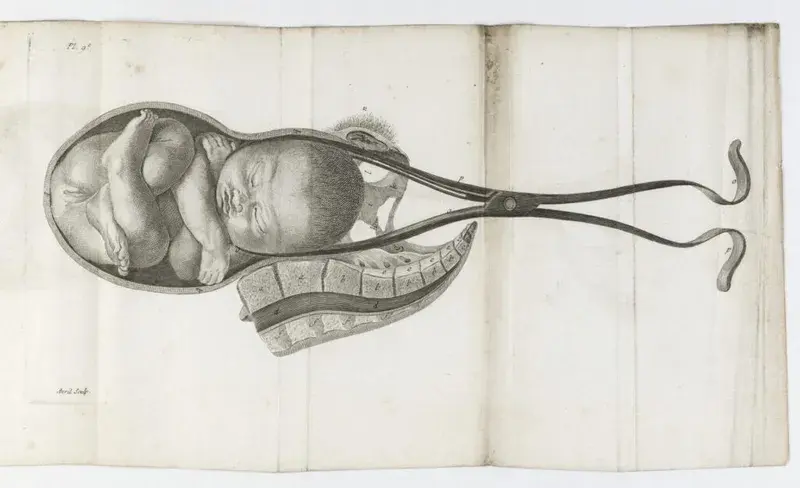
These men were physicians and surgeons, university-educated, socially elite, attending royalty. Midwives were frequently illiterate, female, working-class and easy to dismiss regardless of their actual outcomes.
By the mid-1700s the balance flipped: Dr William Smellie alone trained 900 man-midwives in a decade, and "lying-in hospitals" sprang up specifically so men could get supervised practice on poor women in exchange for free care.
By 1902 it took an Act of Parliament for midwives to even regain professional status.
Women handing over their bodies to the more 'credentialed', more socially powerful voice in the room is something that still absolutely lingers today...
If you've ever felt that flicker of doubt in front of a consultant, wondering if they must know something about your body that you don't, that right there is three hundred years of conditioning talking.

Dirty doctors...
Things spiralled from there; more and more women were dying in childbirth from ever before; an ice cold fear rippled through communities now when a woman went into labour, and we started moving outside of the home and into 'medical facilities'.
In these facilities doctors would take women straight to an operating theatre (basically a table with a cloth sheet) and use their instruments to 'assist'.
They would have been teaching 'up and coming' doctors in the morning, dissecting cadavers (dead bodies!)... and then heading to a birth to insert instruments and hands inside a labouring mother.
Without using soap. And without the invention of antibiotics.
Unsurprisingly - death rates soared.
Proof that doctors were killing women by going straight from the dissection table to the birthing bed wasn't figured out until 1847, with a Dr called Ignaz Semmelweis in Vienna.
He noticed the maternity ward staffed by medical students (who also performed autopsies) had a death rate of over 13% from 'childbed fever' (infection), while the ward staffed by midwives (who didn't touch cadavers and 'inserted themselves' far less) had under 2%.
When his friend died of an infection identical to 'childbed fever' after a scalpel nick during an autopsy, Semmelweis made the connection: doctors were carrying "cadaverous particles" on their hands.
He ordered handwashing with chlorinated lime; death on his ward dropped from over 12% to under 2% within a month.
Germ theory didn't exist yet, so he couldn't explain why it worked, and the medical establishment rejected him outright.
It took decades for Drs to begin the simple act of washing their hands, even once it had been proved that this would save lives. Because doing so would be admitting they were wrong, that they didn't know everything, and that simplicity actually does save lives.
My love... none of this is proof that birth itself is dangerous. It's proof of what happens when birth gets handled by people more invested in protecting their own authority than admitting they got it wrong.
Act 3 - The long shadow...
Let's fast forward to the 20th century. 15% of women are now birthing in medical hospitals but only those with known medical conditions or sometimes wealthier women who by this point saw the 'educated' Drs as a superior option (a belief that still lingers!)
We are starting to loose what was once an understood and sacred rite of passage and birth now has an inherent undertone of fear and risk.
BUT - most women are still birthing at home, with midwives.
Yes, they are now 'doctor trained' medical midwives rather than the old 'wise woman village midwives'... but the wisdom and knowledge about how to help with along it's merry way without instruments, machines or drugs is alive and strong.
Where there is fear in birth there is pain, and also where there are men observing birth from a 'clinical' observational perspective there were opportunities to try and 'free' women from the pain of childbirth (don't get me started on the purpose of pain in birth - a lesson for another blog!)

Twilight sleep...
From around 1914 Drs were administering a combination of morphine and scopolamine, developed in Freiburg, Germany, that didn't remove pain - it removed the memory of pain.
Women were strapped down, blindfolded, and given ear plugs because they thrashed and screamed throughout; they simply didn't remember it afterwards.
It was championed in the US by early feminists who saw "the right to forget" as a feminist win, and it drove a marked rise in forceps use and prolonged second-stage labour.
It had largely faded out in the US by the 1920s, but versions persisted for decades, with even Queen Elizabeth 11 using it for her first 3 births (Prince Charles, Princess Anne, and Prince Andrew) until 1960.

Shaving and enemas...
Up until the 1980s (and later) it became common practice to be shaved 'down there' by a Dr and given an enema; both were standard admission procedure in hospital births for the better part of the 20th century, justified by infection theory that nobody had actually tested.
When Cochrane finally reviewed the evidence, the result was clear: enemas don't reduce infection, don't shorten labour, and routine shaving has no benefit either.
The World Health Organisation formally recommended against both in 1996.
A recent obstetric review describing this era put it plainly: an entire "admission ritual" of shaving, enema, IV, no food, flat on the back, continuous monitoring was dismantled piece by piece once anyone actually checked whether it worked.
These aren't some ancient barbaric practices - your own grandmother's or Mother's generation may have been shaved and given an enema before being allowed to have her baby, on no evidence whatsoever... ('Good girl' / 'white coat' syndrome anyone?!)
By this point we have become so conditioned to say yes, not make a fuss and give all of our dignity and power away in the face of 'medical authority'.
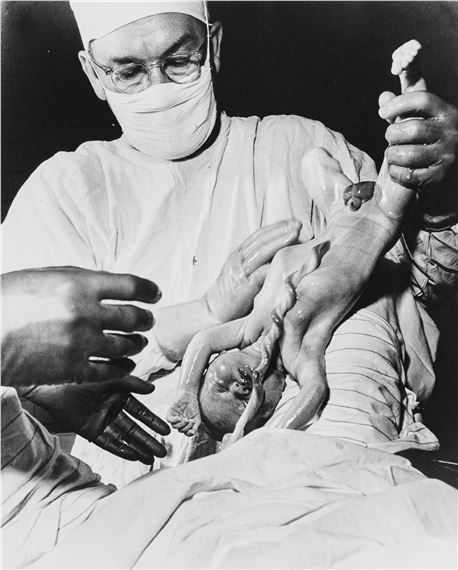
So how many women were actually birthing at home at this point?
Well, actually until the 60s - most!
It wasn't until 1963 - 1974 that home birthing rates dropped dramatically, plummeting from 30% of births happening at home to just 4.2%
By 1988 (the year I was born, in a hospital!) we were down to just 0.9% of births happening at home. 0.9%!

Act 4 - Red thread and hope for us modern home birthers...
I'm painting a rather bleak and sad picture, aren't I?!
Sorry chuck... but chin up. There is always hope.
Throughout this history there have always been glimmers, women and birth workers striving to keep that 'red thread' of wisdom going. Pockets of communities who stepped outside of the insanity that their medical system was wreaking on the general populations.
Folks like Ina May Gaskin, who ran a community called 'The Farm' in the 1970s, where they practiced traditional, wise woman midwifery and had a 95% successful home birth rate (not too different to my own 92% home birth rate for clients!)
Or Jane Hardwicke Collins and Rachel Reed who have dedicated their lives to continuing to share red thread wisdom with women of our generation.

Women birthing their own babies in their own homes, attended by strong, experienced wise women is still a deep desire for a LOT of women in our modern society.
We don't yearn for home birth out of nostalgia, or because we want an 'aesthetic' looking fairy lit birth in a pool (although - lush).
Planning a Home birth is one of the single most preventative factors a woman can do if she's wanting to avoid life changing, traumatic interventions such as induction, epidural, assisted (forceps) birth or an unplanned c section.
Evidence, research, personal stories and the lived experience of women, midwives and Doulas shows us this over and over again.
The thing women had for most of human history - someone they knew deeply, by their side as a steady, present, and trusted presence, the whole way through their labour - isn't a 'nice-to-have' we've evolved past.
It's the single most evidence-backed thing in modern maternity care, and it's also the thing modern maternity care is worst at actually providing.
A Cochrane's review (the gold standard in medical research) of continuous labour support found it reduces the likelihood of unplanned caesarean birth, reduces low Apgar scores (how well a baby is doing after birth) in newborns, and improves women's overall satisfaction with their birth experience... with no identified harms, and the effect is strongest specifically when the support person is in an independent doula role rather than hospital staff.
ACOG's own clinical guidance now states this explicitly: continuous one-to-one support is associated with shorter labour, less need for pain medication, fewer instrumental deliveries, and less dissatisfaction with the birth experience.

And women are starting to rise up against accepting the medical model of care, one which assumes every single woman is broken. Social media, books, podcasts and specialised courses like the Born at Home™ Online course are spreading the word:
Home Birth is a valid, safe, beautiful option for a lot of women.
Yes, there are circumstances where we are incredibly grateful and understanding of modern birth interventions.

But for the most part... we can look at the context in which home birth has been taken from us by the medical model, and objectively, intellectually and intuitively decide whether birthing at home is a safe option for us.
We look back to remember where we have come from - long lines of women who birthed their babies surrounded by love, trust and respect. We also come from a shorter line of women who were forced to birth in fear, medicated and alone.
We're at a point in history where we are perilously close to loosing the red thread.
Let's do our part in keeping the knowledge, love and trust flowing.

Jessica Ord is a home birth doula and creator of the UK's only specialised online home birth course, Born at Home™ guiding couples to prepare deeply for home and free birth through wisdom, physiology, and intuition. Her work is grounded in ancient feminine knowing and rooted in modern, evidence-based care.
Jessica's in person services include private birth doula support, in person birth preparation and holistic pregnancy massage from her pregnancy studio in Northumberland.
If you'd like to find out more about the online course or working with Jessica in person (across the North East of England) head to the button below.


Comments